
How to Hand Brew a Delicious Cup of Coffee at Home
A great cup of pour over coffee does not require complicated equipment, and it does not have to come from a café. What truly matters is fresh coffee beans, the right tools, stable water flow, and attention to every detail.
The beauty of hand brewing coffee at home lies in the process itself. From the aroma released when opening a coffee storage canister, to the moment hot water slowly enters the dripper, to the coffee dripping into the server one drop at a time — every step makes the cup feel warmer, more personal, and more ritualistic.
1. Start With Fresh Coffee Beans
The flavor of pour over coffee depends greatly on the freshness of the coffee beans.
Once coffee beans are exposed to air, moisture, light, and heat, their aroma slowly fades. Even if you use a good dripper and kettle, stale beans can make the final cup taste flat and dull.
Before brewing pour over coffee at home, it is helpful to prepare a well-sealed coffee storage canister.
It helps to:
- Reduce air exposure
- Protect beans from moisture
- Preserve the original aroma of the coffee
- Keep your coffee corner clean and organized
A good storage canister is not just a storage accessory. It is the first step in the pour over brewing process.
2. Grind The Coffee Beans: The Foundation Of Flavor
For pour over coffee, it is best to grind the beans right before brewing.
After coffee beans are ground, their aroma escapes more quickly. Avoid grinding too much in advance. Grinding fresh before each brew helps create a cleaner and fuller flavor.
A beginner-friendly ratio is:
15g coffee grounds : 250g hot water
The recommended grind size is medium-fine, similar to fine sand.
If the coffee tastes too sour or too weak, the grind may be too coarse.
If the coffee tastes too bitter or astringent, the grind may be too fine.
3. Choose The Right Dripper
The dripper affects water flow speed and extraction.
There are two common types of drippers:
Cone-Shaped Dripper
A cone-shaped dripper focuses water flow toward the center. The extraction speed is usually faster, and the flavor is often cleaner, brighter, and more layered.
It is suitable for people who enjoy fruity acidity, floral notes, and a more expressive cup.
Flat-Bottom Dripper
A flat-bottom dripper creates a more even coffee bed and more stable water flow. It is usually more beginner-friendly.
It is suitable for people who prefer a balanced, sweet, and stable flavor.
If you are just starting to brew coffee at home, choosing a stable and easy-to-use dripper can help you make a more balanced cup.
4. Filters Also Affect Taste
Many people overlook filters, but filters directly affect the clarity and mouthfeel of coffee.
Paper filters can remove some oils and fine particles, making the coffee taste cleaner and lighter. Different filter shapes need to match different drippers. For example, cone filters work with cone-shaped drippers, while wave filters work with flat-bottom drippers.
Before brewing, rinse the filter with hot water.
This helps to:
- Reduce paper taste
- Preheat the dripper and server
- Help the filter fit the dripper better
After rinsing, remember to pour out the water from the server.
5. Pour Over Kettle: Make Water Flow More Stable
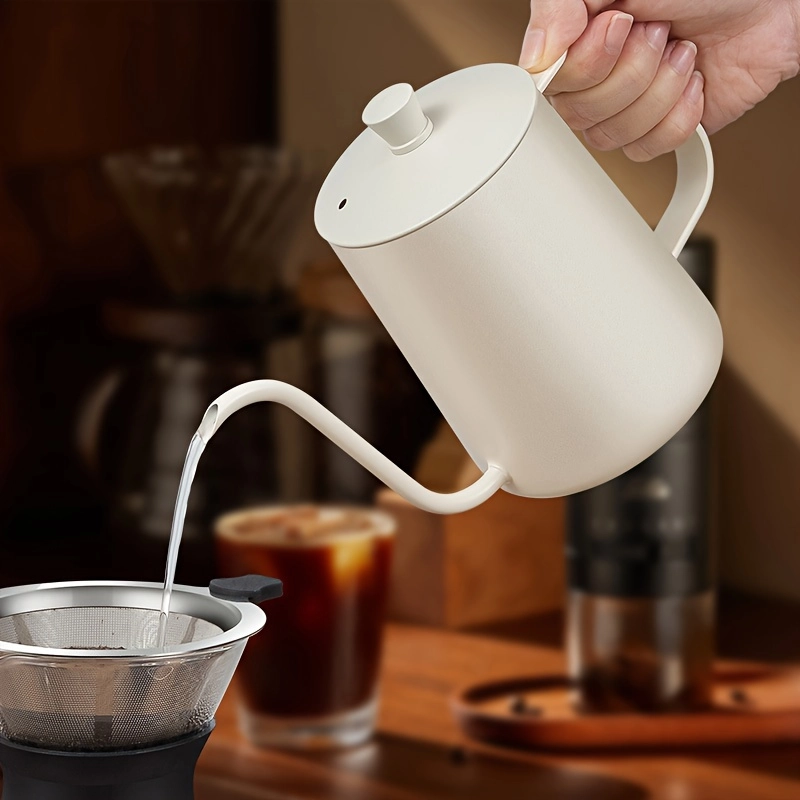
A pour over kettle is one of the most important tools in pour over coffee.
A regular kettle often pours too fast or too widely, which can disturb the coffee bed and lead to uneven extraction. A pour over kettle usually has a slim gooseneck spout, helping you control the water flow more steadily.
A good pour over kettle helps you:
- Control pouring speed
- Control pouring position
- Saturate coffee grounds more evenly
- Reduce over-extraction or under-extraction
- Add a stronger sense of ritual to the brewing process
The flavor of pour over coffee often lives in the stability of the water flow.
6. Start The Extraction
Here is a beginner-friendly pour over method for home brewing.
Brewing Parameters
- Coffee grounds: 15g
- Hot water: 250g
- Water temperature: 90°C–94°C
- Grind size: medium-fine
- Total brew time: 2 minutes 30 seconds – 3 minutes 30 seconds
Step 1: Place And Rinse The Filter
Place the filter in the dripper and rinse it completely with hot water. This also preheats the dripper and server.
Pour out the rinse water.
Step 2: Add Coffee Grounds
Add the freshly ground coffee into the dripper and gently level the coffee bed.
The flatter the coffee bed, the easier it is for water to flow evenly.
Step 3: First Pour — Blooming
Pour in about twice the weight of the coffee grounds.
For example:
15g coffee grounds, first pour 30g hot water
Wait for about 30 seconds.
This step is called “blooming.” It allows gas to escape from the coffee grounds and helps the following extraction become more even.
Step 4: Second Pour — Begin Extraction
Start from the center and pour slowly in circular motions with the pour over kettle.
Avoid pouring directly onto the edge of the filter, and do not pour too aggressively. The goal is to let the coffee grounds absorb water evenly, not to disturb the coffee bed.
You can pour until the total water reaches about half of the final amount, around 120g–150g.
Step 5: Third Pour — Reach The Final Water Amount
Continue pouring steadily until the total water reaches 250g.
After pouring, allow the coffee to drain naturally.
If the total brew time is too short, the coffee may taste weak or sour.
If the total brew time is too long, the coffee may taste bitter or astringent.
Step 6: Swirl And Enjoy
Once the dripping is complete, remove the dripper.
Gently swirl the server to make the coffee concentration more even, then pour it into a cup and enjoy.
This is the most charming part of pour over coffee: what you taste is not only the coffee, but also the process you completed by hand.
7. How To Adjust The Flavor
When brewing pour over coffee at home, you do not need to make it perfect the first time. You can adjust it based on taste.
If The Coffee Tastes Sour Or Weak
Try:
- Grinding a little finer
- Using slightly hotter water
- Pouring more slowly
- Extending the extraction time
If The Coffee Tastes Bitter Or Astringent
Try:
- Grinding a little coarser
- Using slightly cooler water
- Pouring more gently
- Shortening the extraction time
If The Coffee Tastes Unclean
Check whether:
- The filter was rinsed properly
- The coffee grounds were evenly ground
- The water flow was too aggressive
- The coffee beans were stored properly
The most interesting part of pour over coffee is that every brew can be adjusted until you slowly find your ideal flavor.
8. What Core Tools Do You Need For Pour Over Coffee At Home?
If you want to build a complete home coffee corner, you can start with these tools:
Coffee Storage Canister
Used to preserve coffee bean freshness and reduce the effects of air, moisture, and light.
Coffee Grinder
Allows you to grind beans right before brewing and preserve more aroma.
Pour Over Kettle
Helps create stable water flow and more precise pouring.
Dripper
Controls water flow and extraction rhythm. It is one of the core tools in pour over coffee.
Filter
Affects coffee clarity, flow rate, and mouthfeel.
Server Or Coffee Cup
Used to collect the brewed coffee and make the whole brewing process feel more complete and ritualistic.
Digital Scale
Helps control the ratio of coffee grounds to water, making each brew more consistent.
9. Pour Over Coffee Is Not Just A Method, But A Lifestyle
Instant coffee focuses on speed. Capsule coffee focuses on standardization. Pour over coffee focuses more on participation.
It asks you to take part in every step: weighing, grinding, rinsing the filter, pouring, waiting, and tasting. This process is not meant to make life complicated. It gives you a quiet moment that truly belongs to you in the middle of a fast-paced day.
A clean coffee corner, a comfortable pour over kettle, a suitable dripper, and a storage canister that preserves aroma can all make this daily routine feel more refined.
The beauty of pour over coffee is not only in the taste of the final cup, but also in your willingness to pause for it.